


Forged Fittings
Your Professional Forged Fittings Supplier
Hebei Senhai Pipeline Co., Ltd. is one professional manufacturer of ERW, SAW and SMLS steel pipes, as per standards of API5L, API 5CT, ASTM, EN, BS, DIN, GOST, GB, etc. Senhai Pipeline is located in Cangzhou City, which is the famous "Hometown of Pipes and Fittings" in China, about 120km away from Tianjin Seaport and Airport, and 180km from capital Beijing. Senhai especially produces welded steel pipes of large diameter and thick wall thickness in ERW, LSAW and SSAW. Anti-corrosion layers can also be done in our factory.





Sales Market
Senhai's products are popular in many countries and districts like Southeast Asia, Mid-East, Europe, America, Australia, South America, Africa, etc. "Customer's satisfaction, highly-qualified products and outstanding services" are treasured by Senhai as the business principle.
Our Certifications
Materials include A106 Gr.B, A53 Gr.B, API 5L PSL1 PSL2 X42~X70 L245 L290 L360, Q235A, Q235B, Q235C, Q345B~F, 10#, 20#, 45# steel, A105, WPB, etc., all of which meet the standards of ASTM, API, BS, DIN, JIS, EN, GOST, GB, etc. following standards including ISO9002,ASTM A234 GR WPB ASME/ANSI B16.9,DIN2605-1/2 2615 2617, JISB2311 2312, EN10253-1/2/3, GOST 17375 17376 17378 17379 GOST 30753, etc.
Production Equipment
The major production equipment owned by Senhai cover the hot-rolling puncher, interactive double core bar cold drawing machine, automatically rotary head rolling machine, tube straightening machine, annealing furnace without water cooling system and auxiliary equipment of surface scouring and coating.
Our Factory
Occupying total area of 33,000 square meters, Senhai possesses workshops of four hot rolling production lines, two cold drawing production lines, four welded pipe production lines and office building. The major production equipment owned by Senhai cover the hot-rolling puncher, interactive double core bar cold drawing machine, automatically rotary head rolling machine, tube straightening machine, annealing furnace without water cooling system and auxiliary equipment of surface scouring and coating.
Specification
|
Size |
1/8" to 4"NB |
|
Material Specification |
Carbon Steel Stainless Steel SS316 |
|
Class Pressure |
3000 PSI 6000 PSI |
|
Connection Type |
Threaded (NPT or BSPP) Socket Weld (Weld In) |
Size
|
DN |
Nominal Pipe Size |
Center to End Elbow, Tee, Cross A |
Center to End 45 Deg. Elbow C |
Outside Diameter of Bend H |
Minimum Wall Thickness G |
Length of Thread Min. (1) |
|||||||||
|
2000 |
3000 |
3000 |
2000 |
3000 |
3000 |
2000 |
3000 |
3000 |
2000 |
3000 |
3000 |
B |
L2 |
||
|
6 |
1/8* |
21 |
21 |
25 |
17 |
17 |
19 |
22 |
22 |
25 |
3.18 |
3.18 |
6.35 |
6.4 |
6.7 |
|
8 |
1/4* |
21 |
25 |
28 |
17 |
19 |
22 |
22 |
25 |
33 |
3.18 |
3.30 |
6.60 |
8.1 |
10.2 |
|
10 |
3/8* |
25 |
28 |
33 |
19 |
22 |
25 |
25 |
33 |
38 |
3.18 |
3.51 |
6.98 |
9.1 |
10.4 |
|
15 |
1/2* |
28 |
33 |
38 |
22 |
25 |
28 |
33 |
38 |
46 |
3.18 |
4.09 |
8.15 |
10.9 |
13.6 |
|
20 |
3/4* |
33 |
38 |
44 |
25 |
28 |
33 |
38 |
46 |
56 |
3.18 |
4.32 |
8.53 |
12.7 |
13.9 |
|
25 |
1* |
38 |
44 |
51 |
28 |
33 |
35 |
46 |
56 |
62 |
3.68 |
4.98 |
9.93 |
14.7 |
17.3 |
|
32 |
1-1/4* |
44 |
51 |
60 |
33 |
35 |
43 |
56 |
62 |
75 |
3.89 |
5.28 |
10.59 |
17.0 |
18.0 |
|
40 |
1-1/2* |
51 |
60 |
64 |
35 |
43 |
44 |
62 |
75 |
84 |
4.01 |
5.56 |
11.07 |
17.8 |
18.4 |
|
50 |
2* |
60 |
64 |
83 |
43 |
44 |
52 |
75 |
84 |
102 |
4.27 |
7.14 |
12.09 |
19.0 |
19.2 |
|
65 |
2-1/2* |
76 |
83 |
95 |
52 |
52 |
64 |
92 |
102 |
121 |
5.61 |
7.65 |
15.29 |
23.6 |
28.9 |
|
80 |
3* |
86 |
95 |
106 |
64 |
64 |
79 |
109 |
121 |
146 |
5.99 |
8.84 |
16.64 |
25.9 |
30.5 |
Factors that may put you at risk
Steel is extremely strong, so it is often used in support structures such as buildings, pipes, and roads. Unlike other types of steel, steel does not corrode.
Reliability
Due to its reliability, steel is a terrific material for fireproof building homes, hurricane-proof, tornado-proof, and earthquake-proof when compared to many other materials.
Does not harm the environment
Various other materials are more difficult to recycle than carbon steel, which makes them more ecologically beneficial.
Affordable
It is cheaper to make carbon steel pipes, for example than copper pipes due to their thinness. In that regard, it is a more economical metal than other metals.
Household material
Carbon steel is more beneficial for dents and scratches than aluminum material which is generally used in cooking ware. Carbon steel is useful in kitchenware as it is healthful and does not damage easily.
Key Application Areas of a Forged Fittings
Petrochemical: Forged fittings are widely used in petrochemical industry, common equipment including distillation columns, hydrogenation reactors, gas storage tanks, petroleum compressors and so on. These equipment need to withstand high pressure, high temperature, strong corrosion and other extreme working conditions during the working process, the high strength and corrosion resistance of forged pipe fittings can ensure the safety and stability of the equipment.
Natural gas: Natural gas pipeline pipe fittings are mainly used in the forging process. As the natural gas transmission process requires a large number of pressurisation and depressurisation operations, the high strength and deformation resistance of forged pipe fittings can ensure the safety and reliability of the pipeline.
Fertiliser: Fertiliser production process requires high temperature and high pressure reaction, forged pipe fittings have better deformation resistance and corrosion resistance, widely used in the field of fertiliser.
Metallurgy: Metallurgy in the field of high temperature and high pressure processing needs to use a variety of pipe fittings, such as deformer, furnace pipe, high temperature zirconia pipe, heat-resistant furnace fittings. The high strength and high temperature and pressure resistance of forged tube fittings can ensure the safe operation of the equipment.
Machinery: Forged tube fittings are widely used in the field of machinery, such as ships, automobiles and other fields. Forged tube fittings have higher load capacity and stability, and can adapt to different mechanical working environment.
Marine: The requirements for pipes and fittings in the marine sector are very high, with the need to withstand high pressure, high temperature, severe corrosion and other harsh marine environments. Forged pipe fittings have higher strength and corrosion resistance to ensure the safe operation of ships.
Aerospace: Forged seamless tubes are increasingly used in high-end manufacturing sectors such as aerospace due to their excellent physical properties. These materials have become the key to promoting industrial upgrading.
Key Features of Forged Fittings

High strength
Due to the use of forging process, the forged pipe fittings in the internal grain structure is more compact, thus effectively improving its tensile, bending and other aspects of strength.
Good abrasion resistance
Due to the close internal grain structure of forged fittings, their surface hardness is greater, making them more wear resistant.
Controllable quality
The forging process is more stable, easy to control the quality of the production process, for more stringent product quality requirements are more applicable.
Tees
Forged tees are a type of forged steel fitting that is used to combine or divide the flow of a liquid. Reducing Tees are a specific type of tee that allows for pipe size change. The run outlets of a tee are the two in-line outlets, and the branch is the third reducing outlet.
Elbows
A pipe elbow is a forged steel fitting that has been installed between two lengths of pipe or tube that allows a change of direction, usually by 90° or 45°. Reducing elbows can both simultaneously change flow direction and reduce flow diameter.
Couplings
Couplings are a forged steel fitting that is used to connect two lengths of pipe. One end is screwed into the pipe while the other end can be tightly inserted, or welded, onto the other end to pipe or vessel.
Unions
Unions are similar to a coupling but allow two lengths of pipe to be assembled and detached without causing any deformation to the pipes.
Bushings
Bushings are forged steel fittings that allow for a change in pipe size.
Caps
Caps are just as the name suggest – they cap the flow by being inserted over the end of the pipe.
Plugs
Similar to a cap, plugs stop the flow of a liquid in the pipe. They come in different head types, such as hex, square, and round.
Crosses
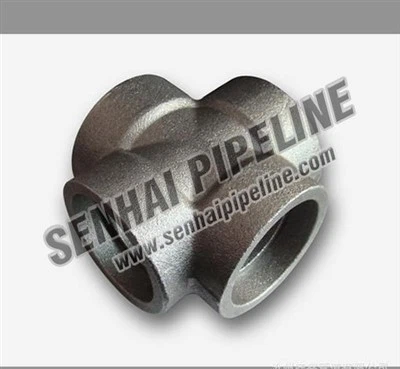
As you would expect, crosses are a 4-way fitting. They have one inlet and three outlets or vice versa and allow for four pipes to meet together. The diameter of the outlets and inlets can be the same or different.
Our Certificate


FAQ