Forged fittings are essential components in various industrial applications, offering strength, durability, and reliability. As a leading forged fittings supplier, we understand the importance of these components and the role that magnetic properties play in their performance. In this blog post, we will explore the magnetic properties of forged fittings, their implications, and how they can impact your industrial operations.


Understanding Magnetic Properties
Magnetism is a fundamental property of matter that arises from the movement of electric charges. In the context of forged fittings, magnetic properties are determined by the composition of the material and its microstructure. Ferromagnetic materials, such as iron, nickel, and cobalt, exhibit strong magnetic properties and can be magnetized easily. Paramagnetic materials have a weaker magnetic response, while diamagnetic materials are repelled by magnetic fields.
The magnetic properties of forged fittings can have several implications for their use in industrial applications. For example, in some industries, such as food processing and pharmaceuticals, the presence of magnetic particles can contaminate products and pose a risk to consumer safety. In other industries, such as oil and gas, magnetic properties can affect the performance of equipment and sensors.
Magnetic Properties of Common Forged Fitting Materials
Carbon Steel
Carbon steel is one of the most commonly used materials for forged fittings due to its strength, affordability, and versatility. Carbon steel is ferromagnetic, which means it can be magnetized. The magnetic properties of carbon steel can vary depending on the carbon content and the heat treatment process. Higher carbon content generally results in stronger magnetic properties.
In industrial applications, the magnetic properties of carbon steel forged fittings can be both an advantage and a disadvantage. On one hand, the magnetic properties can be used for non - destructive testing (NDT) methods such as magnetic particle inspection, which can detect surface and near - surface defects. On the other hand, in applications where magnetic interference is a concern, the ferromagnetic nature of carbon steel may need to be considered. For instance, in some electronic or communication systems, the magnetic field generated by carbon steel fittings could interfere with sensitive equipment.
Stainless Steel
Stainless steel is another popular material for forged fittings, known for its corrosion resistance. There are different types of stainless steel, and their magnetic properties vary. Austenitic stainless steels, such as 304 and 316, are generally non - magnetic or have very low magnetic permeability. This is because their crystal structure is face - centered cubic (FCC), which does not allow for easy alignment of magnetic domains.
Ferritic and martensitic stainless steels, on the other hand, are ferromagnetic. Ferritic stainless steels have a body - centered cubic (BCC) crystal structure, which allows for magnetic behavior. Martensitic stainless steels are also ferromagnetic and can be hardened by heat treatment. The choice between magnetic and non - magnetic stainless steel forged fittings depends on the specific application requirements. For example, in applications where magnetic interference is a concern, austenitic stainless steel fittings would be preferred.
Impact of Magnetic Properties on Forged Fitting Applications
Welding and Joining
The magnetic properties of forged fittings can have an impact on the welding and joining processes. In magnetic materials, the magnetic field can cause arc blow during welding. Arc blow is a phenomenon where the welding arc is deflected from its intended path, resulting in poor weld quality, porosity, and lack of fusion. To mitigate arc blow, special welding techniques and equipment may be required when welding ferromagnetic forged fittings.
Non - Destructive Testing
As mentioned earlier, the magnetic properties of forged fittings can be utilized for non - destructive testing. Magnetic particle inspection (MPI) is a widely used NDT method for ferromagnetic materials. In MPI, a magnetic field is applied to the fitting, and magnetic particles are then applied to the surface. If there are any surface or near - surface defects, the magnetic field lines will be disrupted, and the magnetic particles will accumulate at the defect location, making it visible. This method is highly sensitive and can detect small defects that may not be visible to the naked eye.
Equipment Compatibility
In industrial settings, forged fittings need to be compatible with other equipment and systems. In applications where magnetic fields are present, such as in some electrical or electronic equipment, the magnetic properties of the fittings can affect the performance of the overall system. For example, in a sensor - based system, magnetic interference from ferromagnetic fittings could cause inaccurate readings.
Our Range of Forged Fittings and Their Magnetic Properties
As a forged fittings supplier, we offer a wide range of products with different magnetic properties to meet the diverse needs of our customers. Our Bw Olets are available in both carbon steel and stainless steel. The carbon steel Bw Olets are ferromagnetic and can be used in applications where magnetic properties are not a concern or where they can be utilized for NDT. The stainless steel Bw Olets, especially those made from austenitic stainless steel, are non - magnetic and are suitable for applications where magnetic interference needs to be avoided.
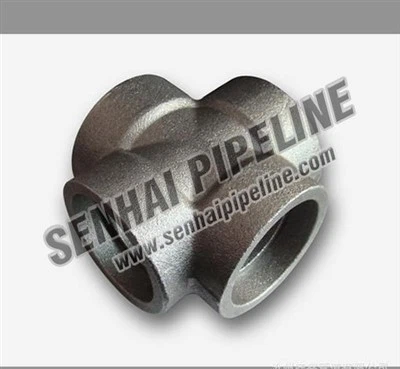
Our Carbon Steel Forged Cross is a ferromagnetic product. It is commonly used in piping systems where strength and durability are required. The magnetic properties of the carbon steel forged cross can be used for quality control during manufacturing through MPI.
We also offer Socket Welded Olets in various materials. The magnetic properties of these olets depend on the material of construction. Whether you need a magnetic or non - magnetic socket welded olet, we can provide the right product for your application.
Choosing the Right Forged Fittings Based on Magnetic Properties
When selecting forged fittings, it is crucial to consider the magnetic properties based on your specific application requirements. Here are some factors to consider:
- Application Environment: If the fitting will be used in an environment where magnetic interference can affect other equipment or processes, choose non - magnetic materials such as austenitic stainless steel.
- Quality Control: If you need to perform non - destructive testing on the fittings, ferromagnetic materials like carbon steel or ferritic stainless steel are more suitable as they can be inspected using magnetic particle inspection.
- Welding Requirements: If welding is involved, be aware of the potential for arc blow in ferromagnetic materials and take appropriate measures to ensure good weld quality.
Conclusion
The magnetic properties of forged fittings are an important consideration in industrial applications. Understanding the magnetic behavior of different materials, such as carbon steel and stainless steel, can help you make informed decisions when selecting the right fittings for your project. As a forged fittings supplier, we are committed to providing high - quality products with the appropriate magnetic properties to meet your specific needs.
If you are in the market for forged fittings and need further assistance in choosing the right products based on magnetic properties or other requirements, we encourage you to contact us. Our team of experts is ready to engage in a detailed discussion about your project and provide you with the best solutions. We look forward to the opportunity to work with you and contribute to the success of your industrial operations.
References
- ASME B16.11 - Forged Fittings, Socket - Welding and Threaded
- ASTM A105/A105M - Standard Specification for Carbon Steel Forgings for Piping Applications
- ASTM A350/A350M - Standard Specification for Carbon and Low - Alloy Steel Forgings, Requiring Notch Toughness Testing for Piping Components