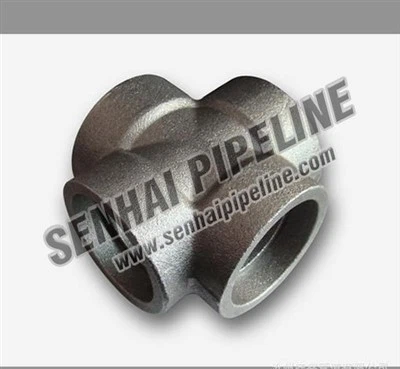
When it comes to industrial pipe systems, forged lateral tees play a crucial role in ensuring the efficient and reliable flow of fluids and gases. As a leading supplier of forged lateral tees, I often receive inquiries about the hardness of these essential components. In this blog post, I will delve into the concept of hardness in forged lateral tees, exploring its significance, measurement methods, and the factors that influence it.
Understanding Hardness in Forged Lateral Tees
Hardness is a fundamental property of materials that refers to their resistance to permanent deformation, such as indentation, scratching, or wear. In the context of forged lateral tees, hardness is a critical characteristic that directly impacts their performance, durability, and suitability for specific applications. A forged lateral tee with the appropriate hardness can withstand the stresses and pressures associated with fluid and gas flow, ensuring long-term reliability and safety in industrial pipe systems.


Significance of Hardness in Forged Lateral Tees
The hardness of a forged lateral tee is of utmost importance for several reasons. Firstly, it determines the tee's resistance to wear and abrasion. In applications where the fluid or gas being transported contains abrasive particles, a harder tee will be less likely to experience premature wear, which can lead to leaks, reduced flow rates, and costly downtime. Secondly, hardness affects the tee's ability to withstand high pressures. A tee with sufficient hardness can maintain its structural integrity under extreme pressure conditions, preventing failures and ensuring the safety of the entire pipe system. Finally, hardness is also related to the tee's machinability and weldability. A tee with the right hardness can be easily machined to the required specifications and welded without compromising its mechanical properties.
Measurement of Hardness in Forged Lateral Tees
There are several methods available for measuring the hardness of forged lateral tees, each with its own advantages and limitations. The most commonly used methods include the Brinell hardness test, the Rockwell hardness test, and the Vickers hardness test.
- Brinell Hardness Test: This test involves pressing a hardened steel or carbide ball of a specified diameter into the surface of the tee under a known load for a specified period of time. The diameter of the resulting indentation is then measured, and the Brinell hardness number (BHN) is calculated based on the load and the diameter of the indentation. The Brinell hardness test is suitable for measuring the hardness of large and relatively soft materials, but it may not be appropriate for very hard or thin materials.
- Rockwell Hardness Test: This test uses a diamond cone or a hardened steel ball indenter to make an indentation in the surface of the tee. The depth of the indentation is measured, and the Rockwell hardness number is determined based on the difference in depth before and after the application of the load. The Rockwell hardness test is a quick and easy method that can be used to measure the hardness of a wide range of materials, including hard and thin materials. However, it may not be as accurate as the Brinell or Vickers hardness tests for some materials.
- Vickers Hardness Test: This test involves pressing a square-based diamond pyramid indenter into the surface of the tee under a known load for a specified period of time. The diagonal length of the resulting indentation is then measured, and the Vickers hardness number (HV) is calculated based on the load and the diagonal length of the indentation. The Vickers hardness test is a very accurate method that can be used to measure the hardness of a wide range of materials, including very hard and thin materials. However, it is a more time-consuming and expensive method compared to the Brinell and Rockwell hardness tests.
Factors Affecting the Hardness of Forged Lateral Tees
The hardness of a forged lateral tee is influenced by several factors, including the material composition, the forging process, and the heat treatment.
- Material Composition: The type and amount of alloying elements in the steel used to manufacture the forged lateral tee can significantly affect its hardness. For example, steels with higher carbon content generally have higher hardness, while steels with alloying elements such as chromium, nickel, and molybdenum can also increase the hardness and other mechanical properties of the tee.
- Forging Process: The forging process involves shaping the steel into the desired tee shape by applying pressure and heat. The forging process can have a significant impact on the hardness of the tee. For example, a tee that is forged at a higher temperature and with a greater amount of deformation may have a higher hardness compared to a tee that is forged at a lower temperature and with less deformation.
- Heat Treatment: Heat treatment is a process that involves heating and cooling the forged lateral tee to achieve the desired mechanical properties, including hardness. Different heat treatment processes, such as annealing, quenching, and tempering, can be used to adjust the hardness of the tee. For example, quenching and tempering can significantly increase the hardness of the tee, while annealing can reduce the hardness and improve the ductility of the tee.
Hardness Requirements for Different Applications
The hardness requirements for forged lateral tees vary depending on the specific application. For example, in applications where the tee is exposed to high temperatures and pressures, such as in power generation plants or oil and gas pipelines, a higher hardness may be required to ensure the tee's resistance to deformation and failure. On the other hand, in applications where the tee is used in a relatively low-pressure and low-temperature environment, such as in water supply systems or HVAC systems, a lower hardness may be sufficient.
It is important to note that the hardness requirements for forged lateral tees are typically specified by industry standards and regulations. For example, the American Society of Mechanical Engineers (ASME) and the American Petroleum Institute (API) have established standards for the hardness of forged fittings used in various industries. As a supplier of forged lateral tees, I ensure that all of our products meet or exceed these industry standards to ensure the quality and reliability of our products.
Related Forged Fittings
In addition to forged lateral tees, we also offer a wide range of other forged fittings, including Carbon Steel Threaded Elbow, Hexagonal Caps, and Forged Couplings. These fittings are also available in a variety of materials and hardness levels to meet the specific requirements of our customers.
Conclusion
The hardness of a forged lateral tee is a critical property that directly impacts its performance, durability, and suitability for specific applications. As a supplier of forged lateral tees, I understand the importance of providing our customers with high-quality products that meet or exceed their expectations. By carefully controlling the material composition, the forging process, and the heat treatment, we are able to produce forged lateral tees with the appropriate hardness for a wide range of applications.
If you are in need of forged lateral tees or other forged fittings, please do not hesitate to contact us. Our team of experts will be happy to assist you in selecting the right products for your specific needs and provide you with competitive pricing and excellent customer service.
References
- ASME Boiler and Pressure Vessel Code
- API Standards for Pipe Fittings
- ASTM Standards for Steel Forgings