Hey there! As a supplier of Swage Nipples, I've had my fair share of discussions about how these little components can impact fluid flow in pipes. So, I thought I'd dive into this topic and share some insights.


First off, let's quickly understand what Swage Nipples are. Swage Nipples are pipe fittings that are used to connect pipes of different sizes. They have one end with a larger diameter and the other with a smaller diameter, allowing for a smooth transition between pipes of varying dimensions. You can check out more about them Swage Nipples.
Now, when it comes to fluid flow in pipes, there are a few key factors at play, and Swage Nipples can have a significant influence on them.
Flow Velocity
One of the most obvious effects of Swage Nipples on fluid flow is on the velocity of the fluid. When a fluid moves from a larger - diameter pipe to a smaller - diameter pipe through a Swage Nipple, the velocity of the fluid increases. This is based on the principle of the conservation of mass, which states that the mass flow rate of a fluid remains constant in a closed system.
The mass flow rate (ṁ) is given by the equation ṁ = ρAV, where ρ is the density of the fluid, A is the cross - sectional area of the pipe, and V is the velocity of the fluid. Since ρ and ṁ are constant, when the cross - sectional area (A) decreases (as it does when moving from a larger to a smaller pipe), the velocity (V) must increase.
Conversely, when the fluid moves from a smaller - diameter pipe to a larger - diameter pipe through a Swage Nipple, the velocity of the fluid decreases. This change in velocity can have both positive and negative impacts depending on the application.
For example, in a fire sprinkler system, increasing the fluid velocity through a Swage Nipple can help ensure that the water reaches the sprinkler heads with enough force to effectively extinguish the fire. On the other hand, in a system where sediment or debris is present in the fluid, a sudden increase in velocity might cause the sediment to erode the walls of the smaller pipe over time.
Pressure Drop
Another important aspect affected by Swage Nipples is the pressure drop in the pipe system. Pressure drop refers to the decrease in pressure as the fluid flows through the pipe and fittings. When the fluid passes through a Swage Nipple, especially when there is a significant change in pipe diameter, there is an associated pressure drop.
The pressure drop across a Swage Nipple can be calculated using the Bernoulli's equation, which takes into account the changes in velocity, elevation, and pressure of the fluid. In general, a larger change in pipe diameter will result in a larger pressure drop.
A high pressure drop can be a problem in some systems. For instance, in a water supply system, a large pressure drop might mean that the water pressure at the end - user's location is too low. This can lead to issues such as weak water flow from taps or showers. However, in some cases, a controlled pressure drop can be beneficial. For example, in a hydraulic system, a pressure drop across a Swage Nipple can be used to regulate the flow and pressure of the hydraulic fluid.
Turbulence
Swage Nipples can also introduce turbulence in the fluid flow. Turbulence occurs when the fluid flow becomes chaotic, with irregular fluctuations in velocity and pressure. When a fluid passes through a Swage Nipple, especially if the change in diameter is abrupt, the flow can become turbulent.
Turbulence can have several implications. On the positive side, it can enhance the mixing of fluids in a pipe. For example, in a chemical processing plant, if two different fluids need to be mixed thoroughly, introducing turbulence through a Swage Nipple can help achieve better mixing.
However, turbulence also has its drawbacks. It can increase the energy losses in the system due to increased friction between the fluid and the pipe walls. This means that more energy is required to pump the fluid through the system, which can lead to higher operating costs.
Impact on Different Types of Fluids
The effect of Swage Nipples on fluid flow can vary depending on the type of fluid. For Newtonian fluids, such as water and most gases, the relationships between velocity, pressure, and flow are relatively straightforward and can be predicted using well - established equations.
Non - Newtonian fluids, on the other hand, can behave differently. These fluids, which include substances like toothpaste, paint, and some polymers, do not follow the simple linear relationship between shear stress and shear rate. When a non - Newtonian fluid passes through a Swage Nipple, the changes in velocity and pressure can cause the fluid to exhibit complex behaviors, such as shear - thinning or shear - thickening.
Shear - thinning fluids become less viscous as the shear rate (related to the velocity gradient) increases. So, when passing through a Swage Nipple and experiencing an increase in velocity, a shear - thinning fluid might flow more easily. Shear - thickening fluids, on the other hand, become more viscous as the shear rate increases, which can lead to unexpected pressure drops and flow restrictions.
Comparing with Other Pipe Fittings
It's also interesting to compare Swage Nipples with other pipe fittings in terms of their impact on fluid flow. For example, Union is a type of pipe fitting that is used to connect two pipes together in a way that allows for easy disassembly. Unions generally have a relatively smooth internal surface, and they cause less disruption to the fluid flow compared to Swage Nipples, especially when it comes to introducing turbulence.
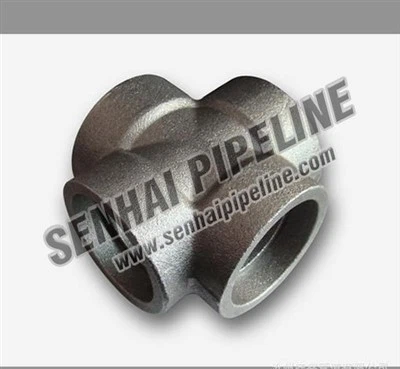
Another fitting is the Socket Welded Equal Tee. This fitting is used to split or combine fluid flow in a pipe system. While a Socket Welded Equal Tee can also cause changes in velocity and pressure, the nature of these changes is different from those caused by a Swage Nipple. The Tee fitting typically distributes the fluid flow in multiple directions, which can lead to more complex flow patterns compared to the simple diameter - change - based effects of a Swage Nipple.
Conclusion
In conclusion, Swage Nipples play a crucial role in influencing the flow of fluids in pipes. They can change the velocity, pressure, and turbulence of the fluid, and their impact can vary depending on the type of fluid and the specific application.
As a supplier of Swage Nipples, I understand the importance of providing high - quality fittings that are designed to minimize negative impacts on fluid flow while maximizing the benefits. Whether you're working on a small plumbing project or a large industrial system, choosing the right Swage Nipple is essential for ensuring efficient and reliable fluid flow.
If you're in the market for Swage Nipples or have any questions about how they might fit into your pipe system, don't hesitate to reach out. I'm here to help you make the best choices for your specific needs.
References
- White, F. M. (2011). Fluid Mechanics. McGraw - Hill.
- Incropera, F. P., & DeWitt, D. P. (2002). Introduction to Heat Transfer. Wiley.
- Daugherty, R. L., Franzini, J. B., & Finnemore, E. J. (1985). Fluid Mechanics with Engineering Applications. McGraw - Hill.