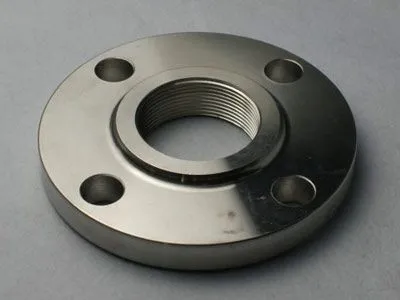
Welding Neck Flanges are crucial components in various industrial piping systems, known for their reliability and strength. As a Welding Neck Flange supplier, ensuring high - quality products is not just a goal but a necessity. In this blog, I'll delve into the quality control measures we implement to guarantee that our Welding Neck Flanges meet and exceed industry standards.
Material Inspection
The foundation of a high - quality Welding Neck Flange lies in the raw materials. We start by carefully selecting our suppliers. Only those who can provide materials with proper certifications are considered. For example, the steel used in our flanges must have a mill test report (MTR) that details its chemical composition and mechanical properties.
We conduct in - house material analysis using advanced techniques such as spectroanalysis. This method allows us to precisely determine the elements present in the steel, ensuring that it meets the required standards. For instance, the carbon content, which can significantly affect the weldability and strength of the flange, must be within a specific range. If the carbon content is too high, the flange may become brittle, while too low a content can lead to insufficient strength.
In addition to chemical analysis, we also perform physical inspections on the raw materials. This includes checking for surface defects such as cracks, porosity, or inclusions. These defects can compromise the integrity of the final product, so any material with such flaws is immediately rejected.
Dimensional Accuracy
Dimensional accuracy is of utmost importance for Welding Neck Flanges. They need to fit perfectly into the piping system, and any deviation can lead to leaks or other operational issues. We use precision measuring tools such as calipers, micrometers, and coordinate measuring machines (CMMs) to ensure that every flange meets the specified dimensions.
The outer diameter, inner diameter, thickness, and bolt hole sizes are all carefully measured at multiple points. For example, the bolt hole diameters must be within a very tight tolerance to ensure that the bolts can be easily inserted and tightened without any binding. We also check the flatness of the flange face, as an uneven face can prevent a proper seal when the flange is connected to the pipe.
Our manufacturing processes are designed to minimize dimensional variations. We use computer - controlled machining equipment that can reproduce the same dimensions with high precision. Regular calibration of these machines is carried out to maintain their accuracy.
Weld Quality
Since Welding Neck Flanges are designed to be welded to the pipe, the quality of the weld is critical. We have a team of highly skilled welders who are certified to perform the welding operations. They follow strict welding procedures that are based on industry standards such as ASME (American Society of Mechanical Engineers) codes.
Before starting the welding process, the edges of the flange and the pipe are prepared properly. This includes cleaning the surfaces to remove any dirt, grease, or oxide layers. The welding parameters such as current, voltage, and welding speed are carefully controlled to ensure a strong and defect - free weld.
We perform non - destructive testing (NDT) on the welds to detect any internal defects. Techniques such as ultrasonic testing (UT), radiographic testing (RT), and magnetic particle testing (MT) are used. Ultrasonic testing can detect internal flaws such as lack of fusion or porosity deep within the weld. Radiographic testing provides a detailed image of the weld, allowing us to identify any hidden defects. Magnetic particle testing is used to detect surface and near - surface defects in ferromagnetic materials.
Heat Treatment
Heat treatment is often used to improve the mechanical properties of Welding Neck Flanges. After the welding process, the flanges may undergo heat treatment to relieve residual stresses and enhance their toughness and strength.
We carefully control the heat treatment process, including the heating rate, soaking time, and cooling rate. For example, during annealing, the flange is heated to a specific temperature and held there for a certain period to allow the internal stresses to be relieved. Then, it is slowly cooled to room temperature to prevent the formation of new stresses.
After heat treatment, we conduct hardness testing to ensure that the flanges have the desired mechanical properties. Hardness is an important indicator of the flange's resistance to wear and deformation.
Surface Finish
The surface finish of the Welding Neck Flange not only affects its appearance but also its performance. A smooth surface finish can reduce the risk of corrosion and improve the sealing ability of the flange.
We use various surface finishing techniques such as grinding, polishing, and coating. Grinding is used to remove any rough edges or burrs left after machining. Polishing can give the flange a smooth and shiny surface, which is not only aesthetically pleasing but also more resistant to corrosion.
We also apply protective coatings to the flanges to prevent corrosion. These coatings can be made of materials such as epoxy or zinc. The thickness and adhesion of the coating are carefully monitored to ensure its effectiveness.
Final Inspection
Before the Welding Neck Flanges are shipped to our customers, a final inspection is carried out. This is a comprehensive check that includes all the aspects mentioned above, such as material quality, dimensional accuracy, weld quality, heat treatment, and surface finish.
We also perform a visual inspection to ensure that the flange looks good and there are no obvious defects. Each flange is then marked with relevant information such as the material grade, size, and manufacturing date. This allows for easy traceability in case of any issues in the future.
Related Products
If you are interested in other types of flanges, we also offer Long Welding Neck Flange, Orifice Flange Facing, and Lap Joint Flange. These products also undergo the same rigorous quality control measures to ensure their reliability.


Contact Us for Procurement
We understand that the quality of Welding Neck Flanges is crucial for your industrial operations. Our commitment to quality control ensures that you receive products that are not only reliable but also compliant with industry standards. If you are in need of high - quality Welding Neck Flanges or any of our other flange products, we invite you to contact us for procurement. We are ready to discuss your specific requirements and provide you with the best solutions.
References
- ASME Boiler and Pressure Vessel Code
- API (American Petroleum Institute) Standards
- AWS (American Welding Society) Welding Standards