Are there international standards for flanges? This is a question that often arises in the industrial and manufacturing sectors. As a flange supplier, I've had numerous discussions with clients about this topic. In this blog post, I'll delve into the world of flange standards, exploring whether there are truly international benchmarks and how they impact our business.
The Importance of Flange Standards
Flanges are essential components in piping systems, used to connect pipes, valves, pumps, and other equipment. They provide a way to create a leak - tight seal and allow for easy disassembly and maintenance. Without proper standards, the compatibility of flanges from different manufacturers would be a significant challenge.
Imagine a scenario where a company in one country manufactures flanges with a certain bolt hole pattern, size, and pressure rating, while another company in a different country has a completely different set of specifications. When these flanges need to be connected in a large - scale international project, it would lead to delays, increased costs, and potential safety hazards.
Existing International Flange Standards
There are indeed international standards for flanges, although they are not always uniformly adopted across the globe. The two most well - known sets of standards are the ASME (American Society of Mechanical Engineers) standards in the United States and the EN (European Norm) standards in Europe.
The ASME standards, specifically ASME B16.5 and ASME B16.47, cover a wide range of flange types, including weld neck, slip - on, threaded, and blind flanges. These standards define the dimensions, pressure - temperature ratings, and material requirements for flanges. For example, ASME B16.5 specifies the dimensions for flanges with nominal pipe sizes from NPS 1/2 to NPS 24, and it provides detailed tables for flange thickness, bolt hole size, and number of bolts based on the pressure class.
On the other hand, the EN standards, such as EN 1092 - 1, are used in Europe. These standards also cover various flange types and provide similar information about dimensions and pressure ratings. However, there are some differences between the ASME and EN standards. For instance, the bolt hole patterns and flange face finishes may vary, which can cause compatibility issues when using flanges from different regions.
In addition to ASME and EN, there are also ISO (International Organization for Standardization) standards. ISO 7005 is an international standard for metallic flanges. It aims to harmonize the design and dimensions of flanges across different countries. ISO standards are often used in international projects where a common set of specifications is required to ensure compatibility and interchangeability.
Impact on My Business as a Flange Supplier
As a flange supplier, these international standards play a crucial role in our operations. We need to ensure that the flanges we produce comply with the relevant standards to meet the requirements of our clients. When a client requests a specific type of flange, we first need to clarify which standard they are referring to.
For example, if a client from the United States places an order, we are likely to manufacture the flanges according to ASME standards. However, if the client is from Europe or is involved in an international project that follows ISO standards, we will adjust our production process accordingly.
We also offer a wide range of flange types to meet different client needs. For instance, we have Carbon Steel Plate Flange, which are commonly used in low - pressure applications. These flanges are made of carbon steel and are designed to be welded or bolted to the pipe. They are cost - effective and easy to install, making them a popular choice for many industries.


Another type of flange we supply is the Long Welding Neck Flange. These flanges are used in high - pressure and high - temperature applications. The long neck provides additional reinforcement and reduces stress concentration at the weld joint. They are often used in critical piping systems in the oil and gas, chemical, and power generation industries.
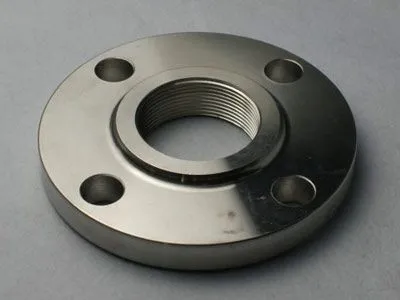
We also have Carbon Steel Threaded Flange. These flanges are suitable for small - diameter pipes and are easy to install without welding. They are commonly used in low - pressure and non - critical applications, such as plumbing and HVAC systems.
Challenges in Adhering to International Standards
While international standards provide a framework for flange manufacturing, there are still challenges in adhering to them. One of the main challenges is the constant evolution of standards. Both ASME and EN standards are periodically updated to incorporate new materials, manufacturing techniques, and safety requirements. As a supplier, we need to stay up - to - date with these changes and ensure that our production processes are compliant.
Another challenge is the interpretation of standards. Different countries and even different companies may have different interpretations of the same standard. This can lead to disputes and misunderstandings between suppliers and clients. To address this issue, we have a team of experts who are well - versed in the various standards and can provide accurate technical support to our clients.
Future Trends in Flange Standards
The future of flange standards is likely to involve further harmonization. As the global economy becomes more interconnected, there is a growing need for a single set of international standards that can be adopted worldwide. ISO standards are expected to play a more significant role in this process.
There is also a trend towards the development of standards for new materials and applications. For example, with the increasing use of composite materials and high - performance alloys in the industry, there will be a need for standards that define the design and performance requirements for flanges made from these materials.
Conclusion
In conclusion, there are international standards for flanges, but they are a complex landscape with multiple sets of standards in use around the world. As a flange supplier, we need to navigate this complexity to meet the diverse needs of our clients. By offering a wide range of flange types that comply with different standards, we can provide solutions for various industries and applications.
If you are in need of high - quality flanges for your project, whether it's a small - scale plumbing job or a large - scale industrial installation, we are here to help. Our team of experts can assist you in selecting the right type of flange and ensuring that it meets the necessary standards. Contact us today to start a discussion about your flange requirements and let's work together to find the best solution for your project.
References
- ASME B16.5 - Pipe Flanges and Flanged Fittings
- ASME B16.47 - Large Diameter Steel Flanges
- EN 1092 - 1 - Flanges and their joints - Circular flanges for pipes, valves, fittings and accessories, PN designated - Part 1: Steel flanges
- ISO 7005 - Metallic flanges