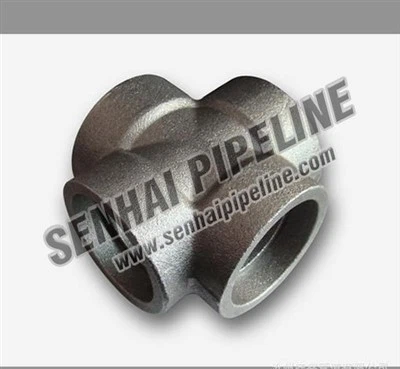
The maximum flow rate that a Pipe Fittings Cross can handle is a crucial consideration for anyone involved in fluid conveyance systems. As a dedicated supplier of Pipe Fittings Cross, I've witnessed firsthand the importance of understanding this metric to ensure the efficiency and safety of various industrial and commercial applications.
Factors Influencing the Maximum Flow Rate
The maximum flow rate of a Pipe Fittings Cross is determined by several factors. First and foremost is the pipe size. Larger diameter pipes generally allow for higher flow rates because they offer less resistance to the fluid. For instance, a 6 - inch Pipe Fittings Cross can handle a significantly larger volume of fluid per unit time compared to a 2 - inch one. This is due to the increased cross - sectional area, which provides more space for the fluid to flow through.
The material of the Pipe Fittings Cross also plays a vital role. Different materials have different levels of internal roughness. For example, a cross made of smooth - walled stainless steel will have less friction compared to one made of cast iron with a relatively rough interior. Less friction means less resistance to the fluid flow, allowing for a higher maximum flow rate.
The fluid properties are another key factor. Viscosity, density, and temperature all affect how easily a fluid can flow through the Pipe Fittings Cross. High - viscosity fluids, such as heavy oils, flow more slowly than low - viscosity fluids like water. As the viscosity increases, the resistance to flow also increases, reducing the maximum flow rate that the cross can handle. Temperature can also impact viscosity; for most fluids, an increase in temperature leads to a decrease in viscosity, which in turn can increase the flow rate.
Calculating the Maximum Flow Rate
To calculate the maximum flow rate, engineers often use the Darcy - Weisbach equation, which takes into account the friction factor, pipe length, diameter, and the head loss. However, this equation can be complex and requires detailed knowledge of the system. A simpler approach is to refer to industry - standard flow rate charts. These charts are based on extensive testing and provide a quick way to estimate the maximum flow rate for different pipe sizes and fluid types.
For example, if you are using a Pipe Fittings Cross in a water supply system, you can find a chart that shows the relationship between the pipe diameter and the maximum flow rate at a given pressure. These charts typically assume a certain level of pipe roughness and fluid properties, so it's important to make adjustments if your actual conditions deviate from the standard.
Real - World Applications
In industrial settings, Pipe Fittings Crosses are used in a wide range of applications, from chemical processing plants to oil refineries. In a chemical processing plant, the maximum flow rate of the Pipe Fittings Cross determines how quickly chemicals can be transferred between different processing units. If the flow rate is too low, it can slow down the entire production process, leading to decreased efficiency and increased costs.
In a water treatment facility, the Pipe Fittings Cross is used to distribute water to different treatment stages. Ensuring that the cross can handle the required flow rate is essential for maintaining the quality and quantity of the treated water. If the flow rate exceeds the maximum capacity of the cross, it can cause pressure drops, leaks, and even damage to the piping system.
Complementary Pipe Fittings
Pipe Fittings Crosses are often used in conjunction with other pipe fittings, such as Carbon Steel Reducers and Carbon Steel Tee. Carbon Steel Reducers are used to connect pipes of different diameters, which can affect the flow rate. By reducing the pipe diameter, the fluid velocity increases, which can sometimes be necessary to maintain a certain flow rate in a system.


Carbon Steel Tees, on the other hand, are used to split or combine fluid flows. When used in combination with a Pipe Fittings Cross, they can help manage the flow distribution in a more complex piping network. However, it's important to ensure that the overall system is designed to handle the flow rates at each junction to avoid pressure imbalances and inefficiencies.
Importance of Quality in Pipe Fittings Cross
As a supplier of Pipe Fittings Cross, I understand the importance of quality in determining the maximum flow rate. High - quality fittings are manufactured to precise specifications, which ensures a smooth interior surface and accurate dimensions. This reduces friction and allows for a more efficient flow of fluid.
Poor - quality Pipe Fittings Crosses may have irregularities in the internal surface, such as bumps or ridges, which can increase the resistance to flow. They may also have inconsistent wall thickness, which can lead to pressure variations and reduced flow rates. By choosing high - quality Pipe Fittings Crosses from a reliable supplier, you can ensure that your system operates at its optimal flow rate.
Contact for Procurement
If you are in need of Pipe Fittings Cross for your project, I encourage you to reach out for procurement discussions. Whether you are designing a new fluid conveyance system or upgrading an existing one, we can provide you with the right Pipe Fittings Cross to meet your specific requirements. Our team of experts can assist you in selecting the appropriate size and material based on your maximum flow rate needs.
References
- Crane Technical Paper No. 410, Flow of Fluids Through Valves, Fittings, and Pipe.
- Moody, L. F. "Friction Factors for Pipe Flow." Transactions of the ASME, 1944.
- Streeter, V. L., and Wylie, E. B. Fluid Mechanics. McGraw - Hill, 1979.