Hey there! As a supplier of Pipe Fittings Cross, I've had my fair share of conversations with folks about pipe fittings. One question that pops up a lot is, "What's the difference between a Pipe Fittings Cross and other pipe fittings?" Well, that's exactly what I'm gonna dive into in this blog post.
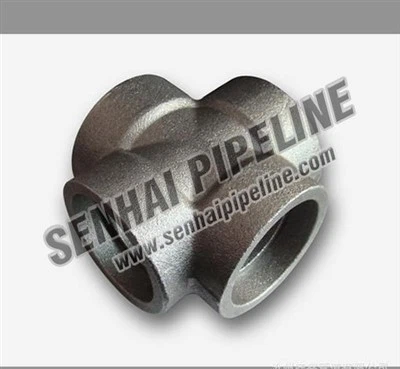
Let's start with the basics. A Pipe Fittings Cross, as the name suggests, has four openings arranged in a cross shape. It allows for the connection of four pipes at right angles to each other. This is super handy in complex piping systems where you need to distribute fluid or gas in multiple directions.
Now, let's compare it to some other common pipe fittings.
Carbon Steel Tee
First up, the Carbon Steel Tee. A tee has three openings - one main run and two branch runs. It's like a fork in the road for your pipes. You use it when you want to split a single pipeline into two separate ones or combine two pipelines into one.
The main difference between a tee and a cross is the number of connections. A tee gives you one extra connection point compared to a straight pipe, while a cross gives you three extra connection points. So, if you have a simple system where you just need to branch off once, a tee is your go-to. But if you're dealing with a more intricate setup where you need to distribute the flow in multiple directions simultaneously, a cross is the better choice.
Carbon Steel Caps
Next, let's talk about Carbon Steel Caps. Caps are used to seal the end of a pipe. They're like little stoppers that prevent fluid or gas from leaking out. Unlike a cross, which is all about making connections and distributing flow, a cap is all about stopping the flow.
You might use a cap when you've got a pipeline that's not currently in use or when you're testing a system and need to block off an end. It's a simple yet essential fitting, but it serves a very different purpose compared to a cross.
Hot Induction Bends
Now, Hot Induction Bends. These are used to change the direction of a pipeline. They're like curves in a road for your pipes. You can get bends in different angles, like 45 degrees or 90 degrees, depending on how much you need to change the direction.
The difference between a bend and a cross is pretty clear. A bend is focused on changing the direction of the flow in a single pipeline, while a cross is about creating multiple connections and distributing the flow among different pipelines. If you're just trying to navigate around an obstacle or follow a specific layout, a bend is what you need. But if you're building a network of pipes that need to intersect and share the flow, a cross is the way to go.


Material and Construction
Another aspect to consider is the material and construction of these fittings. Just like my Pipe Fittings Cross, Carbon Steel Tees, Caps, and Hot Induction Bends are often made from carbon steel. Carbon steel is a popular choice because it's strong, durable, and can withstand high pressures and temperatures.
However, the manufacturing process for each fitting can vary. For example, a cross might be forged or cast, depending on the size and application. Forging gives the fitting more strength and better mechanical properties, while casting is more suitable for complex shapes. Tees, caps, and bends also have their own specific manufacturing methods to ensure they meet the required standards.
Applications
Let's take a look at some real-world applications to understand the differences better.
In a water supply system, you might use a tee to split the main water line into smaller lines for different parts of a building. But if you're building a large industrial water treatment plant, you might need a cross to distribute the water to multiple treatment units simultaneously.
In an oil and gas pipeline, a bend would be used to navigate around natural obstacles like mountains or rivers. A cap might be used to seal off a section of the pipeline during maintenance. And a cross could be used at a junction where multiple pipelines meet to distribute the oil or gas to different storage tanks or processing facilities.
Cost and Availability
Cost is always a factor when choosing pipe fittings. Generally, a cross is more expensive than a tee or a cap because it's more complex to manufacture. It requires more material and a more intricate production process. Bends can also vary in cost depending on the angle and size.
Availability is another consideration. Some fittings might be more readily available in certain sizes or materials than others. As a supplier, I make sure to keep a good stock of Pipe Fittings Cross in different sizes and specifications to meet the needs of my customers.
Conclusion
So, there you have it - the main differences between a Pipe Fittings Cross and other pipe fittings like Carbon Steel Tees, Caps, and Hot Induction Bends. Each fitting has its own unique features, functions, and applications.
If you're in the market for pipe fittings, especially Pipe Fittings Cross, I'd love to have a chat with you. Whether you're working on a small DIY project or a large industrial installation, I can help you find the right fittings for your needs. Just reach out, and we can start discussing your requirements.
References
- "Pipe Fittings Handbook" - A comprehensive guide on different types of pipe fittings and their applications.
- Industry standards and specifications for carbon steel pipe fittings.