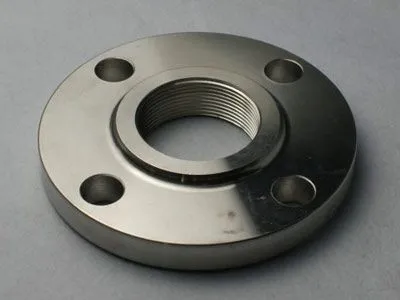
Hey there! As a supplier of Welding Neck Flanges, I've been getting a lot of questions about their thermal properties lately. So, I thought I'd write this blog to break it all down for you.
First off, let's understand what Welding Neck Flanges are. They're a type of flange that has a long tapered hub, which is welded to the pipe. They're commonly used in high-pressure and high-temperature applications because of their strong structural integrity. Now, let's dive into their thermal properties.
Thermal Conductivity
One of the key thermal properties of Welding Neck Flanges is their thermal conductivity. Thermal conductivity is a measure of how well a material can conduct heat. For Welding Neck Flanges, the thermal conductivity depends on the material they're made of. Most of the time, they're made from metals like carbon steel, stainless steel, or alloy steel.
Carbon steel Welding Neck Flanges have a decent thermal conductivity. Carbon steel is a popular choice because it's relatively inexpensive and has good mechanical properties. The thermal conductivity of carbon steel allows it to transfer heat efficiently, which is important in applications where heat needs to be dissipated or transferred. For example, in a pipeline system where the fluid being transported is hot, the carbon steel Welding Neck Flanges can help transfer the heat away from the joints, preventing overheating. You can check out our Carbon Steel Threaded Flange for more details on carbon steel flanges.
Stainless steel Welding Neck Flanges, on the other hand, have a lower thermal conductivity compared to carbon steel. Stainless steel contains chromium, which forms a protective oxide layer on the surface. This layer not only gives stainless steel its corrosion resistance but also reduces its thermal conductivity. However, this can be an advantage in some applications where you want to minimize heat transfer. For instance, in a cryogenic application where you need to keep the cold temperature inside the pipeline, the lower thermal conductivity of stainless steel Welding Neck Flanges can help prevent heat from entering the system.
Alloy steel Welding Neck Flanges are designed to have specific thermal properties depending on the alloying elements added. Some alloy steels are made to have high thermal conductivity for applications that require rapid heat transfer, while others are engineered to have low thermal conductivity for insulation purposes.
Thermal Expansion
Another important thermal property is thermal expansion. When a material is heated, it expands, and when it cools, it contracts. This is known as thermal expansion. Welding Neck Flanges need to be able to withstand the stresses caused by thermal expansion without failing.
The coefficient of thermal expansion (CTE) is a measure of how much a material expands or contracts with a change in temperature. Different materials have different CTE values. Carbon steel has a relatively high CTE compared to some other materials. This means that in a high-temperature application, the carbon steel Welding Neck Flanges will expand more than a material with a lower CTE. If the expansion is not properly accounted for, it can lead to problems such as leaks or even structural failure at the flange joints.
To deal with thermal expansion, engineers often use expansion joints or flexible connectors in the pipeline system. These components can absorb the expansion and contraction of the Welding Neck Flanges, reducing the stress on the joints.
Heat Resistance
Heat resistance is also a crucial thermal property of Welding Neck Flanges. In high-temperature applications, the flanges need to maintain their strength and integrity without deforming or losing their mechanical properties.
Carbon steel Welding Neck Flanges can withstand moderate temperatures. However, at very high temperatures, the carbon steel can start to lose its strength and become more susceptible to corrosion. Stainless steel Welding Neck Flanges, on the other hand, have better heat resistance. The chromium and nickel in stainless steel form a stable oxide layer that protects the metal from oxidation and degradation at high temperatures.
Alloy steel Welding Neck Flanges can be specifically designed to have excellent heat resistance. By adding elements like molybdenum, vanadium, or tungsten, the alloy steel can maintain its strength and hardness even at extremely high temperatures. This makes them suitable for applications such as power plants, refineries, and chemical processing plants where the temperatures can be very high.
Thermal Fatigue Resistance
Thermal fatigue is a phenomenon that occurs when a material is subjected to repeated cycles of heating and cooling. This can cause cracks to form in the material over time, leading to failure. Welding Neck Flanges need to have good thermal fatigue resistance to ensure long-term reliability in applications where there are temperature fluctuations.
The microstructure of the material plays a significant role in its thermal fatigue resistance. For example, a fine-grained microstructure can improve the thermal fatigue resistance of a Welding Neck Flange. Additionally, proper heat treatment during the manufacturing process can also enhance the material's ability to withstand thermal fatigue.
Impact of Thermal Properties on Welding Neck Flange Applications
The thermal properties of Welding Neck Flanges have a big impact on their applications. In the oil and gas industry, where pipelines are used to transport high-temperature fluids, the thermal conductivity and expansion properties of the Welding Neck Flanges are critical. If the flanges can't handle the heat or the expansion, it can lead to costly leaks and downtime.
In the power generation industry, especially in steam turbines and boilers, the heat resistance and thermal fatigue resistance of the Welding Neck Flanges are essential. These components need to operate at high temperatures for long periods without failing.
In the chemical processing industry, the thermal properties of the flanges need to be compatible with the chemicals being processed. For example, in a process where corrosive chemicals are heated, the Welding Neck Flanges need to have good corrosion resistance as well as thermal stability. You can take a look at our Carbon Steel Plate Flange for more options suitable for different industrial applications.
How We Ensure Quality in Thermal Properties
As a supplier of Welding Neck Flanges, we take the thermal properties of our products very seriously. We source high-quality raw materials from reliable suppliers. Our manufacturing process includes strict quality control measures to ensure that the flanges meet the required thermal specifications.
We use advanced testing equipment to measure the thermal conductivity, expansion, and heat resistance of our Welding Neck Flanges. This allows us to guarantee that our products will perform well in the intended applications. For example, we conduct thermal cycling tests to simulate the real-world temperature fluctuations and check for any signs of thermal fatigue.
We also offer customization services. If you have specific thermal requirements for your application, we can work with you to develop Welding Neck Flanges that meet your needs. Whether you need a flange with high thermal conductivity or one with excellent heat resistance, we've got you covered. And if you're interested in the facing of the flanges, check out our Orifice Flange Facing for more information.


Contact Us for Your Welding Neck Flange Needs
If you're in the market for Welding Neck Flanges and want to learn more about their thermal properties or have specific requirements for your project, don't hesitate to get in touch with us. We're here to help you choose the right flanges for your application and ensure that you get the best quality products. Whether it's a small-scale project or a large industrial installation, we can provide you with the solutions you need.
References
- ASME B16.5 - Pipe Flanges and Flanged Fittings
- ASTM Standards for Steel Flanges
- "Materials Science and Engineering: An Introduction" by William D. Callister, Jr. and David G. Rethwisch