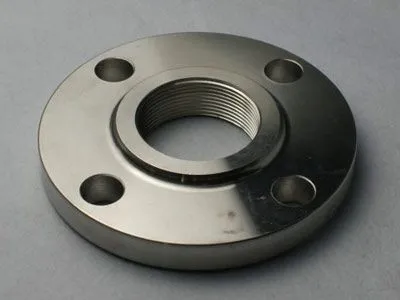
As a seasoned supplier of Welding Neck Flanges, I've witnessed firsthand the importance of understanding the differences between forged and cast Welding Neck Flanges. This knowledge is crucial for clients in various industries, including oil and gas, petrochemical, and power generation, as it directly impacts the performance, reliability, and cost - effectiveness of their piping systems.

Manufacturing Processes
The first significant difference lies in the manufacturing processes of forged and cast Welding Neck Flanges.
Forging is a manufacturing process where metal is shaped by applying compressive forces. In the case of forged Welding Neck Flanges, a solid piece of metal, usually a billet, is heated to a malleable state and then hammered or pressed into the desired shape. This process aligns the grain structure of the metal along the shape of the flange, resulting in a stronger and more uniform material. The intense pressure applied during forging eliminates internal voids and porosity, which could otherwise weaken the flange. For example, in high - pressure applications, the consistent grain structure of forged flanges provides excellent resistance to stress and fatigue.
On the other hand, casting is a process in which molten metal is poured into a mold and allowed to solidify. For cast Welding Neck Flanges, a mold is created with the exact shape of the flange. Once the molten metal is poured into the mold, it takes the shape of the mold as it cools. Casting allows for the production of complex shapes with relative ease. However, the solidification process can sometimes lead to the formation of internal voids, porosity, and uneven grain structures. These imperfections can potentially reduce the mechanical properties of the flange, especially in high - stress applications.

Mechanical Properties
The differences in manufacturing processes translate into distinct mechanical properties for forged and cast Welding Neck Flanges.
Forged Welding Neck Flanges generally have superior mechanical properties. They offer higher tensile strength, yield strength, and ductility compared to cast flanges. Tensile strength refers to the maximum amount of stress a material can withstand before breaking under tension. The aligned grain structure in forged flanges gives them a higher ability to resist pulling forces. Yield strength is the stress at which a material begins to deform plastically. Forged flanges can withstand higher stresses before reaching their yield point, making them suitable for applications where high pressures and loads are present. Ductility, the ability of a material to deform under tensile stress without breaking, is also better in forged flanges. This property is important as it allows the flange to absorb energy during deformation without fracturing, which is crucial in dynamic applications.
Cast Welding Neck Flanges, while still having adequate strength for many applications, may have lower mechanical properties. The presence of internal voids and porosity can act as stress concentrators, reducing the overall strength of the flange. In addition, the uneven grain structure in cast flanges can lead to inconsistent mechanical properties throughout the flange. However, cast flanges can be a cost - effective solution for applications where the pressure and stress requirements are relatively low.
Surface Finish and Dimensional Accuracy
Surface finish and dimensional accuracy are important considerations when choosing between forged and cast Welding Neck Flanges.
Forged Welding Neck Flanges typically have a better surface finish. The forging process results in a smooth and uniform surface, which is beneficial for applications where a tight seal is required. A smooth surface reduces the risk of leakage at the flange joint, which is crucial in industries such as oil and gas where even a small leak can have serious consequences. In terms of dimensional accuracy, forging allows for tight tolerances. This means that the dimensions of forged flanges are more precise, which is essential for proper fit and alignment in piping systems.
Cast Welding Neck Flanges may have a rougher surface finish due to the nature of the casting process. The molten metal can sometimes stick to the mold, leaving behind a less smooth surface. Additionally, achieving high dimensional accuracy in casting can be more challenging. The shrinkage of the metal during solidification can cause slight variations in the dimensions of the flange. However, with advanced casting techniques and quality control measures, these issues can be minimized.
Cost Considerations
Cost is often a determining factor in the selection between forged and cast Welding Neck Flanges.
Forged Welding Neck Flanges are generally more expensive than cast flanges. The forging process requires more energy, labor, and specialized equipment. The raw materials used for forging are also often of higher quality, which adds to the cost. However, the superior mechanical properties and better surface finish of forged flanges can justify the higher cost in applications where reliability and performance are critical. For example, in high - pressure and high - temperature pipelines in the oil and gas industry, the long - term savings in terms of reduced maintenance and downtime can outweigh the initial higher cost of forged flanges.

Cast Welding Neck Flanges are more cost - effective. The casting process is relatively simpler and requires less energy compared to forging. The molds used in casting can be reused multiple times, reducing the production cost per unit. Cast flanges are a popular choice for applications where the operating conditions are less demanding, such as in some low - pressure water or air systems.
Applications
The differences in properties and cost also influence the applications of forged and cast Welding Neck Flanges.
Forged Welding Neck Flanges are commonly used in critical applications where high strength, reliability, and resistance to extreme conditions are required. In the oil and gas industry, they are used in offshore platforms, refineries, and pipelines that transport high - pressure hydrocarbons. The power generation industry also relies on forged flanges for steam and gas turbines, where the flanges need to withstand high temperatures and pressures. Other applications include chemical processing plants, where the flanges are exposed to corrosive chemicals.
Cast Welding Neck Flanges are suitable for less demanding applications. They are often used in low - pressure water distribution systems, ventilation systems, and some industrial applications where the pressure and temperature requirements are relatively low. For example, in a building's plumbing system, cast flanges can be used to connect pipes as the operating conditions are not as severe as in industrial applications.
Other Types of Flanges for Comparison
In addition to forged and cast Welding Neck Flanges, there are other types of flanges available in the market. The Blind Flange is used to close the end of a pipe. It is commonly used for testing or when future access to the pipe is required. The Socket Welding Flange is designed for use with small - diameter pipes. It is welded into place and provides a strong connection. The Long Welding Neck Flange is used in high - temperature and high - pressure applications, similar to forged Welding Neck Flanges, but it has a longer neck, which provides additional flexibility and stress relief.
Conclusion
In conclusion, the choice between forged and cast Welding Neck Flanges depends on various factors, including the application requirements, mechanical properties needed, surface finish and dimensional accuracy, and cost. Forged flanges offer superior mechanical properties, better surface finish, and higher dimensional accuracy but come at a higher cost. They are ideal for critical applications where reliability and performance are of utmost importance. Cast flanges, on the other hand, are more cost - effective and suitable for less demanding applications.
As a Welding Neck Flange supplier, I am committed to providing high - quality products that meet the specific needs of my clients. Whether you require forged or cast Welding Neck Flanges, or any other type of flange such as Blind Flange, Socket Welding Flange, or Long Welding Neck Flange, I can offer you the best solutions. If you are interested in purchasing Welding Neck Flanges or have any questions about the products, please feel free to contact me for a detailed discussion and to start the procurement process.
References
- ASME B16.5 - Pipe Flanges and Flanged Fittings
- API 6A - Specification for Wellhead and Christmas Tree Equipment
- ISO 7005 - Metallic Flanges for Piping