In the realm of industrial machinery and power transmission, the choice of couplings is a critical decision that can significantly impact the performance, efficiency, and reliability of a system. Two types of couplings that often come under consideration are forged couplings and fluid couplings. As a forged couplings supplier, I am well - versed in the features and capabilities of forged couplings, and in this blog, I will delve into a comparison between forged couplings and fluid couplings in terms of torque control.
Torque Control Basics
Torque control is the ability to manage and regulate the amount of rotational force transmitted from a driving shaft to a driven shaft. It is crucial in various applications, such as conveyor systems, pumps, and industrial mixers, where precise control of power transmission can prevent equipment damage, improve energy efficiency, and enhance overall system performance.
Forged Couplings: A Robust Option for Torque Control
Forged couplings are manufactured through a forging process, which involves shaping metal under high pressure. This process results in a coupling with a dense and homogeneous grain structure, making it extremely strong and durable. When it comes to torque control, forged couplings offer several distinct advantages.
Precision and Rigidity
Forged couplings are designed with high precision, which allows for accurate torque transmission. Their rigid construction ensures that there is minimal torsional deflection, meaning that the torque applied at the input shaft is effectively transferred to the output shaft without significant loss. This precision is especially important in applications where precise speed and torque control are required, such as in machine tools and robotics.
High Torque Capacity
Due to their robust design and high - strength materials, forged couplings can handle high levels of torque. They are often used in heavy - duty applications, such as mining equipment and large - scale industrial machinery, where the ability to transmit large amounts of torque is essential. For example, in a mining conveyor system, a forged coupling can reliably transfer the high torque required to move heavy loads over long distances.
Customization for Torque Requirements
As a forged couplings supplier, I understand that different applications have different torque requirements. Forged couplings can be customized to meet these specific needs. We can adjust the size, shape, and material of the coupling to optimize its torque - handling capacity. Whether it's a small - scale application with relatively low torque requirements or a large - scale industrial process demanding high torque, we can design and manufacture a forged coupling that fits the bill.
Fluid Couplings: A Flexible Approach to Torque Control
Fluid couplings, on the other hand, use a hydraulic fluid to transmit torque between the driving and driven shafts. They offer a different approach to torque control compared to forged couplings.
Smooth Torque Transmission
One of the main advantages of fluid couplings is their ability to provide smooth torque transmission. The hydraulic fluid acts as a cushion, absorbing shocks and vibrations during the power - transmission process. This smooth operation is beneficial in applications where sudden torque changes can cause damage to the equipment, such as in automotive transmissions and some industrial pumps.
Slip and Overload Protection
Fluid couplings have the ability to slip, which means that if the load on the driven shaft exceeds a certain limit, the coupling will start to slip instead of transmitting the excessive torque. This provides a form of overload protection for the equipment. For example, in a conveyor system, if the conveyor belt gets jammed, the fluid coupling will slip, preventing damage to the motor and other components.


Soft Start Capability
Fluid couplings offer a soft - start feature, which gradually increases the torque transmitted to the driven shaft. This is particularly useful in applications where a sudden start can cause stress on the equipment. In a large - scale industrial fan, for instance, a fluid coupling can provide a smooth start, reducing the mechanical stress on the fan blades and the motor.
A Comparative Analysis of Torque Control
Torque Accuracy
When it comes to torque accuracy, forged couplings have an edge over fluid couplings. As mentioned earlier, the rigid and precise design of forged couplings allows for accurate torque transmission. In contrast, fluid couplings have some inherent slippage, which can lead to a less accurate torque transfer. This slippage can also vary depending on factors such as temperature and the viscosity of the hydraulic fluid.
Torque Capacity at High Speeds
Forged couplings maintain their high - torque - capacity performance even at high speeds. Their rigid construction and precise design ensure that they can effectively transmit torque without significant degradation. Fluid couplings, however, may experience reduced efficiency at high speeds due to increased fluid friction and heat generation.
Response to Torque Changes
Forged couplings respond quickly to changes in torque. Their rigid structure allows for an immediate transfer of torque, making them suitable for applications where rapid torque adjustments are required. Fluid couplings, on the other hand, have a more gradual response to torque changes due to the inertia of the hydraulic fluid.
Applications and Suitability
The choice between forged couplings and fluid couplings depends largely on the specific application and its torque - control requirements.
Applications Suited for Forged Couplings
- Precision Machinery: In applications such as CNC machines and precision robotics, the high precision and accurate torque transmission of forged couplings are essential for achieving the required levels of accuracy and repeatability.
- Heavy - Duty Industrial Applications: For applications in the mining, steel, and power generation industries, where high torque capacity and reliability are crucial, forged couplings are the preferred choice. For example, in a steel rolling mill, a forged coupling can withstand the high torque and heavy loads associated with the rolling process.
Applications Suited for Fluid Couplings
- Automotive and Transportation: Fluid couplings are commonly used in automotive transmissions, where their smooth torque transmission and soft - start capabilities contribute to a comfortable driving experience.
- Industrial Pumps and Fans: In applications where a smooth start and overload protection are important, such as in large - scale industrial pumps and fans, fluid couplings are often the ideal choice.
Related Forged Fittings
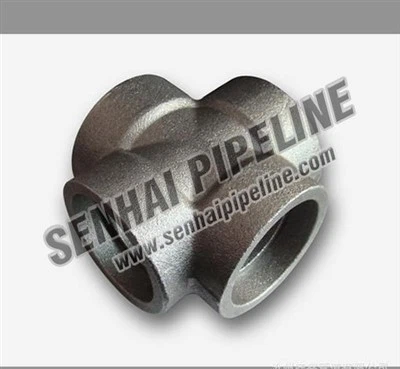
In addition to forged couplings, we also offer a range of other forged fittings that are essential for various industrial applications. Some of our popular products include Carbon Steel Threaded Elbow, Hexagonal Caps, and Carbon Steel Forged Cross. These fittings are manufactured with the same high - quality standards as our forged couplings, ensuring reliable performance in your industrial systems.
Conclusion
In conclusion, both forged couplings and fluid couplings have their unique advantages when it comes to torque control. Forged couplings offer high precision, high torque capacity, and quick response to torque changes, making them suitable for applications that require accurate and reliable torque transmission. Fluid couplings, on the other hand, provide smooth torque transmission, overload protection, and soft - start capabilities, which are beneficial in applications where shock absorption and gradual torque build - up are important.
As a forged couplings supplier, I am committed to providing our customers with the best - in - class products and solutions for their torque - control needs. Whether you need a standard forged coupling or a customized solution, we have the expertise and capabilities to meet your requirements. If you are interested in learning more about our forged couplings or other forged fittings, or if you have specific torque - control needs for your application, please feel free to contact us for a consultation and procurement discussion.
References
- Budynas, R. G., & Nisbett, J. K. (2011). Shigley's Mechanical Engineering Design. McGraw - Hill.
- Harris, T. A. (2001). Rolling Bearing Analysis. Wiley.
- Spotts, M. F., Shoup, T. E., & Smidt, S. A. (2004). Design of Machine Elements. Prentice Hall.