


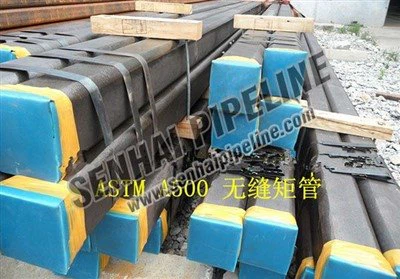
Shs Rhs Smls Or Welded
OD: 20x20mm to 600x600mm
WT: 0.8mm to 50mm
MATERIAL: CS, LTCS
Q195, Q235, Q345, SS330, SS400, SPHC, S235JR, S235JO, S235J2, S355JOH, S355J2H, S355JRH, etc.
STANDARD: ASTM A500, JIS G3466, JIS G3101, BS1387, EN10210, EN10296, EN10025, EN10217, EN10297, EN10219, GB/T6725, GB/T3094, GB/T13793, GB/T3092, GB3640, GOST8639, GOST 8645, GOST8644
HS CODE: 7306
RHS and SHS, can be supplied in welded or seamless.
OD: 20x20mm to 600x600mm
WT: 0.8mm to 50mm
MATERIAL: CS, LTCS
Q195, Q235, Q345, SS330, SS400, SPHC, S235JR, S235JO, S235J2, S355JOH, S355J2H, S355JRH, etc.
STANDARD: ASTM A500, JIS G3466, JIS G3101, BS1387, EN10210, EN10296, EN10025, EN10217, EN10297, EN10219, GB/T6725, GB/T3094, GB/T13793, GB/T3092, GB3640, GOST8639, GOST 8645, GOST8644
HS CODE: 7306
【Product Features】
High-strength Structure
shs rhs smls or welded uses high-strength steel as the main material, with a yield strength of 355MPa and a tensile strength of over 510MPa, ensuring that it remains stable in a complex stress environment. By optimizing the cross-sectional shape design, the moment of inertia of rectangular tubes (Rhs) and square tubes (Shs) is increased by more than 20% compared to conventional tubes, which can effectively disperse external loads and withstand greater weight and pressure when used in construction, machinery manufacturing and other fields.
Corrosion Resistance
The surface of shs rhs smls or welded is treated with hot-dip galvanizing, and the zinc layer thickness reaches more than 85μm, forming a continuous and dense protective layer. The zinc layer reacts metallurgically with the steel matrix to form a Fe-Zn alloy layer, which extends the service life of the steel pipe in ordinary atmospheric environment to more than 25 years, and reduces the corrosion rate by 80% compared with untreated steel pipes.
【Product Application】
Building And Structural Engineering
In building and structural engineering, SHS and RHS are often used in the manufacture of steel structure frames, trusses and beams.
Machinery Manufacturing And Heavy Equipment
In the machinery manufacturing field, SHS and RHS pipes are widely used in the construction of heavy machinery frames, hydraulic supports and industrial robot bases.
Energy Facilities And Pipeline Engineering
In the construction of energy facilities, SHS and RHS pipes are mainly used in the manufacture of power plant boiler support frames, nuclear power plant containment steel structures and oil and gas pipeline supports.
Aerospace And Defense Science And Technology
In the aerospace field, SHS and RHS pipes are mainly used in the manufacture of aircraft landing gear, rocket fuel tanks and satellite supports.
【Frequently Asked Questions】
What is SHS welding technology? What is its core principle?
SHS welding uses the heat released by chemical reactions between reactants to form a high-temperature heat source, and uses the synthetic product as solder to achieve material connection. This technology is driven by self-conduction reaction, does not require external heating, has high efficiency and energy-saving characteristics, and is suitable for gradient welding of dissimilar materials.
How to accurately control the temperature between multiple layers and multiple passes of RHS components?
Use infrared thermometers for real-time monitoring, and cooperate with the welding machine current-time closed-loop control system. When the interlayer temperature exceeds 250℃, the current is automatically reduced by 20%, and when it is lower than 180℃, it is increased by 15%, ensuring that the temperature fluctuation is ≤±10℃.
How to control hydrogen-induced cracks when welding SMLS seamless steel pipes?
It is necessary to strictly implement preheating before welding (≥150℃) and slow cooling after welding, select low-hydrogen welding materials and control the interlayer temperature ≤300℃. For high-strength steel, an austenitic stainless steel electrode transition layer can be used to block the hydrogen diffusion path.
What is the difference between SHS welding and laser welding in heat-affected zone control?
SHS achieves micro-area welding through local rapid heat release, with a heat-affected zone of ≤0.5mm; laser welding relies on high-energy beam deep penetration, with a heat-affected zone of about 1-2mm. The former is more suitable for heat-sensitive materials, while the latter is suitable for thick components.
How to suppress carbon migration when welding RHS dissimilar steels?
A Ni-based transition layer (thickness ≥1.5mm) can be used to block carbon diffusion, or a base material combination with a Cr content difference of ≤5% can be selected.
How to detect and eliminate residual stress in SMLS tube ring welds?
It is recommended to use the blind hole method to measure longitudinal stress, and local induction heating (600-650℃) is used for stress relief.
Can SHS welding be used to connect titanium alloys to alumina ceramics?
It is feasible. It can generate TiC reinforcement phase in situ through the Ti-B4C reaction system, and the shear strength of the joint reaches 45MPa. The vacuum degree needs to be controlled to ≤10⁻²Pa to avoid titanium oxidation, and 2wt% Y2O3 is added to refine the grains.
Can SHS welding achieve functional gradient connection of metal-composite materials?
It is feasible. It can prepare Ti3AlC2/TiC gradient layer through Ti-Al-C system to achieve strength matching between metal matrix and carbon fiber composite materials. The interface shear strength reaches 62MPa, and the fracture toughness KIC=28MPa·m¹/².
Hot Tags: shs rhs smls or welded, China shs rhs smls or welded manufacturers, suppliers, factory, mechanical properties of hollow sections, wholesale hollow sections, malleability of hollow sections, standard hollow sections, chamfering hollow sections, rectangular hollow sections
Previous
No InformationYou Might Also Like




Send Inquiry